Texas A&M Agrilife Extension Logo

Texas A&M Agrilife Extension Logo

Friday, July 5, 2019

Wharton County Field Day

  Howdy,

  Next week we've got our field day coming up, check out our news release before the usual cotton update:
Wharton - AgriLife Extension to host Soybean and Cotton Turn Row Meeting – July 10th

By Corrie Bowen
County Extension Agent
Wharton County

Texas A&M AgriLife Extension, Wharton County Office will host a  Soybean and Cotton Turn Row Meeting on Wednesday, July 10, 2019.  The soybean turn row meeting will begin at 9 a.m. at the Howard and Dolly Wittig Farm in Lane City.  You may have seen the soybean variety plot from Hwy 60 in Lane City.  The soybean plot is located at the corner of Hwy 60 South and CR 122.  The soybean plot is an exceptionally large variety trial, consisting of 47 replicated treatments.  We’re certain to have a lot to look at.  We’ll hear from Dr. Ron Schnell, our AgriLife Cropping Systems Specialist regarding soybean agronomics.  Dr. Tom Isakeit will discuss diseases in soybeans.  Following the visit to the soybean plot we’ll proceed to the Cotton RACE trial in Crescent.
The Cotton turn row meeting will begin at 11 a.m. in Crescent.  The cotton variety trial is located 1 mile south of FM 961 on CR 461.  If you are coming from the Wharton County Fairgrounds on FM 961 S heading toward Wharton, you’ll take the first county road to your right.  Proceed one mile on CR 461 and the plot is on your right.  We have a total of 10 cotton varieties in this year’s Replication Agronomic Cotton Evaluation (RACE) trial, plus two varieties selected by the cooperating grower.  This is also a very large, replicated strip trial.  The purpose of the RACE trial is to generate accurate, replicated yield data on commercially available cotton varieties for our area of Texas.  Dale Mott, Extension Program Specialist for Cotton will discuss current observations in cotton research.  Dr. Tom Isakeit will brief growers on cotton diseases and diagnosis for the 2019 crop as we progress toward harvest.  We’ll plan to conclude the turn row meeting around lunchtime.  2 CEUs will be offered for TDA pesticide license holders and 2 CCA credits have been applied for.  Please call the Extension Office by 12:00 p.m. on July 9 just to let us know that you’ll be attending.  A flyer for the July 10th turn-row meeting is available at https://wharton.agrilife.org The flyer include maps and GPS coordinates for the two turn row meeting locations.  I hope to see you there!
The members of Texas A&M AgriLife will provide equal opportunities in programs and activities, education, and employment to all persons regardless of race, color, sex, religion, national origin, age, disability, genetic information, veteran status, sexual orientation or gender identity and will strive to achieve full and equal employment opportunity throughout Texas A&M AgriLife. The Texas A&M University System, U.S. Department of Agriculture, and the County Commissioners Courts of Texas Cooperating.  Individuals with disabilities who require an auxiliary aid, service or accommodation in order to participate in any Extension activity, are encouraged to contact the County Extension Office for assistance 5 days prior to the activity.

-30-


 This week I've noted beneficial numbers decreasing a little since last week, but still present in locations harboring low numbers of aphids still. We are seeing bollworm eggs, larvae, and damage in the following:


Wharton County

Cry1Ac + Cry1F + Vip3A near Danevang
0% bollworm eggs
2% bollworm larvae
4% bollworm damage

Cry1Ac + Cry2Ab near Blue Creek
0% bollworm eggs
0% bollworm larvae
3% bollworm damage

Cry1Ac + Cry2Ab near Blue Creek
0% bollworm eggs
0% bollworm larvae
5% bollworm damage

Cry1Ac + Cry2Ab near Blue Creek
0% bollworm eggs
0% bollworm larvae
4% bollworm damage  

Cry1Ac + Cry2Ab near Crescent
6% bollworm eggs
2% bollworm larvae- one of those a 1/2" larvae
2% bollworm damage  

Cry1Ac + Cry1F + Vip3A near the Airport
4% bollworm eggs
2% bollworm larvae
9% bollworm damage

Cry1Ac + Cry2Ab + Vip3A near the Wharton County fairgrounds
4% bollworm eggs
2% bollworm larvae
10% bollworm damage

Cry1Ac + Cry2Ab near the Wharton County fairgrounds
10% bollworm eggs
1% bollworm larvae
7% bollworm damage

Cry1Ac + Cry2Ab + Vip3A near Egypt
5% bollworm eggs
0% bollworm larvae
0% bollworm damage

Cry1Ac + Cry2Ab + Vip3A near Elm Grove
11% bollworm eggs
0% bollworm larvae
0% bollworm damage

Jackson County

Cry1Ac + Cry2Ab near El Toro
12% bollworm eggs
6% bollworm larvae
17% bollworm damage

Cry1Ac + Cry2Ab + Vip3A near La Salle
10% bollworm eggs
4% bollworm larvae
12% bollworm damage

Cry1Ac + Cry2Ab + Vip3A near Vanderbilt
4% bollworm eggs
2% bollworm larvae
10% bollworm damage

Matagorda County

Cry1Ac + Cry2Ab + Vip3A near Tidehaven
6% bollworm eggs
0% bollworm larvae
3% bollworm damage

Cry1Ac + Cry2Ab near Tidehaven
2% bollworm eggs
1% bollworm larvae
5% bollworm damage

 Bollworms, Helicoverpa zea, are caterpillars that feed on multiple crops and vegetables. In cotton they feed on squares and bolls, causing fruit loss. These past few years we have had high numbers of this insect in our Bt cotton as well. All the larvae we've found this year have been very small, until this week I found one 1/2" larvae in a field near the Crescent area in Wharton.

H. zea caterpillar in cotton square
Kate Harrell
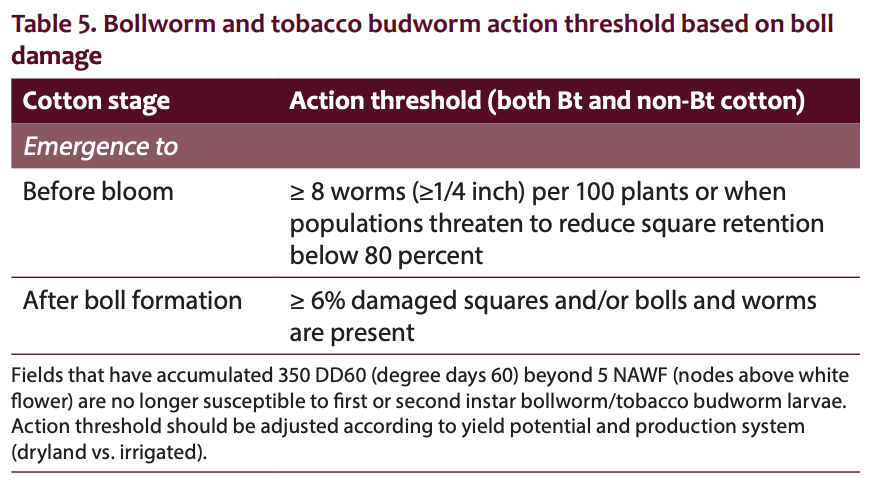
  To scout for cotton bollworms I use the terminal and square inspection method, as well as making some full plant checks, as they can lay eggs anywhere on the plant. I make about four stops in a field, more if the field is larger than 100 acres. At each stop, I look at 25 plant terminals, checking the upper third of the plant for caterpillars and eggs. I also pull 25 half grown or larger green squares to bolls and look for bollworm damage. When documenting egg lay, if I find more than one on a leaf, I only count it as one. The economic threshold for bollworms is 6% damaged bolls with live caterpillars present. In areas like ours on the upper gulf coast with documented Bt failures, the threshold for eggs on single and dual gene cotton is 20% (20 plants out of 100 with at least one egg). If you're finding bollworms in cotton or in corn, especially in viptera fields, please give me a call.
Cotton Insect Guide
 The current A&M recommendation is to use pyrethroids with caution. In areas needing residual control Prevathon at 18-20 fl oz or Besiege at 9-10 fl oz works well. If you don't need residual control you can get by with Prevathon at 14 fl oz or Besiege at 7-8 fl oz.

Cotton Insect Guide

 This week I caught brown and green stink bugs in a field near the Crescent area of Wharton county with 6% damaged fruit, near the airport with 3% damaged fruit with no live stink bugs found, a field near Egypt with 3% damage and no live stink bugs, and a field near Elm Grove with 8% damage and live green stink bugs found. It is still buggy out there, and as our grain finishes out, more of them will move into cotton. To scout for stink bugs pull 10 to 20 bolls about an inch in diameter from four places in the field. Check the inside of the bolls for warts, lesions, and stained lint. Texas economic threshold for stink bugs is 20% or more of the bolls with internal damage and stink bugs present. Some of the brown stink bug populations in our area have also been shown to have some resistance to pyrethroids. 


Green Stink Bug adult
Kate Harrell

Carpal Wall Warts from Stink Bug feeding damage
Kate Harrell

  Below I have included information for stink bug thresholds from a South Carolina guide with good images of what damage looks like in bolls. Our cotton does not bloom as long as theirs, so the week of bloom threshold information will not line up exactly the same for our fields. 

  
  I hope everyone had a happy 4th of July and has a good weekend. If you're not sure what kind of insect or issue you have, feel free to drop by the Wharton county office or give us a call.

Sincerely,

Kate Harrell

Looking for more information? Check out the Cotton Insect Guide

Need help with weed control? Check out the Weed Management Guide


Friday, June 28, 2019

Aphids, Bollworms, and Stink Bugs

  Howdy,

  Most of the cotton in the upper gulf coast is blooming now, so we've shifted most of our concern to stink bugs and bollworms. One constant I have seen in every field I've been in is aphids. This week especially every field I looked at had at least a moderate number of aphids. Our threshold for aphids is 40 to 70 aphids per leaf in cotton before we have open bolls. I've not been in a field with aphid pressure that high yet. If you know you've got them, I would try to avoid using straight pyrethroids to avoid flaring them. Otherwise, the aphids are feeding a healthy beneficial insect population that could help us out some.

 I've seen green and brown stink bugs in all three counties this week. It is still buggy out there, and as our grain finishes out, more of them will move into cotton. To scout for stink bugs pull 10 to 20 bolls about an inch in diameter from four places in the field. Check the inside of the bolls for warts, lesions, and stained lint. Texas economic threshold for stink bugs is 20% or more of the bolls with internal damage and stink bugs present. Some of the brown stink bug populations in our area have also been shown to have some resistance to pyrethroids. 


Green Stink Bug adult
Kate Harrell


Carpal Wall Warts from Stink Bug feeding damage
Kate Harrell

  Below I have included information for stink bug thresholds from a South Carolina guide with good images of what damage looks like in bolls. Our cotton does not bloom as long as theirs, so the week of bloom threshold information will not line up exactly the same for our fields. 


  Bollworms, 
Helicoverpa zea, are caterpillars that feed on multiple crops and vegetables. In cotton they feed on squares and bolls, causing fruit loss. These past few years we have had high numbers of this insect in our Bt cotton as well. So far this year I have not seen bollworms larger than two to three days old. There is egg laying going on, but I have not seen larger caterpillars in cotton yet. I did get a report this week of a few tobacco budworm moths seen flying in the Blue Creek area. The caterpillar and eggs look like that of the bollworm, and our scouting recommendations are the same, but the budworm rarely reaches threshold in our area.


H. zea caterpillar in cotton square
Kate Harrell
  To scout for cotton bollworms I use the terminal and square inspection method, as well as making some full plant checks, as they can lay eggs anywhere on the plant. I make about four stops in a field, more if the field is larger than 100 acres. At each stop, I look at 25 plant terminals, checking the upper third of the plant for caterpillars and eggs. I also pull 25 half grown or larger green squares to bolls and look for bollworm damage. This week I was finding moths flying in almost every field I was in. Egg lay has been fairly light most of this week with an increase in the last two days. I would like to note that while egg lay in the upper third of the cotton plant is typical, I have seen and have talked to consultants finding egg lay near the bottom of the plants. When documenting egg lay, if I find more than one on a leaf, I only count it as one. This caterpillar is highly cannibalistic, and generally only one caterpillar will result from eggs too near each other. The few caterpillars I have seen were very small, likely had only molted once, and were in the crescent area of Wharton county. The economic threshold for bollworms is 6% damaged bolls with live caterpillars present. In areas like ours on the upper gulf coast with documented Bt failures, the threshold for eggs on single and dual gene cotton is 20% (20 plants out of 100 with at least one egg). If you're finding bollworms in cotton or in corn, especially in viptera fields, please give me a call.
Cotton Insect Guide
 The current A&M recommendation is to use pyrethroids with caution. In areas needing residual control Prevathon at 18-20 fl oz or Besiege at 9-10 fl oz works well. If you don't need residual control you can get by with Prevathon at 14 fl oz or Besiege at 7-8 fl oz.

Cotton Insect Guide


El Toro Heat Units

Bay City Heat Units

Wharton Heat Units
  
  I hope everyone stays cool and has a good weekend. If you're not sure what kind of insect or issue you have, feel free to drop by the Wharton county office or give us a call.

Sincerely,

Kate Harrell

Looking for more information? Check out the Cotton Insect Guide

Need help with weed control? Check out the Weed Management Guide


Friday, June 21, 2019

Stink Bugs and Bollworms

  Howdy,

  Most of the cotton in the upper gulf coast is blooming now, and all but one field in my program is blooming. Once cotton begins blooming, we can shift concern for fleahoppers to stink bugs and bollworms.


 I've found multiple species of stink bugs in cotton this week. I've seen green, brown, conchuela, and even had questions on predatory species. It has been a buggy year so far. To scout for stink bugs pull 10 to 20 bolls about an inch in diameter from four places in the field. Check the inside of the bolls for warts, lesions, and stained lint. Texas economic threshold for stink bugs is 20% or more of the bolls with internal damage and stink bugs present. Some of the brown stink bug populations in our area have also been shown to have some resistance to pyrethroids. 

Green Stink Bug adult
Kate Harrell


Carpal Wall Warts from Stink Bug feeding damage
Kate Harrell

  Below I have included information for stink bug thresholds from a South Carolina guide with good images of what damage looks like in bolls. Our cotton does not bloom as long as theirs, so the week of bloom threshold information will not line up exactly the same for our fields. 


  Bollworms, 
Helicoverpa zea, are caterpillars that feed on multiple crops and vegetables. In cotton they feed on squares and bolls, causing fruit loss. These past few years we have had high numbers of this insect in our Bt cotton as well.

H. zea caterpillar in cotton square
Kate Harrell
  To scout for cotton bollworms I use the terminal and square inspection method, as well as making some full plant checks. I make about four stops in a field, more if the field is larger than 100 acres. At each stop, I look at 25 plant terminals, checking the upper third of the plant for caterpillars and eggs. I also pull 25 half grown or larger green squares to bolls and look for bollworm damage. This week I was finding moths flying in almost every field I was in. Egg lay has been fairly light most of this week with an increase in the last two days. I would like to note that while egg lay in the upper third of the cotton plant is typical, I have seen and have talked to consultants finding egg lay near the bottom of the plants. When documenting egg lay, if I find more than one on a leaf, I only count it as one. This caterpillar is highly cannibalistic, and generally only one caterpillar will result from eggs too near each other. The few caterpillars I have seen were very small, likely had only molted once, and were in the crescent area of Wharton county. The economic threshold for bollworms is 6% damaged bolls with live caterpillars present. In areas like ours on the upper gulf coast with documented Bt failures, the threshold for eggs on single and dual gene cotton is 20% (20 plants out of 100 with at least one egg). If you're finding bollworms in cotton or in corn, especially in viptera fields, please give me a call.
Cotton Insect Guide
 The current A&M recommendation is to use pyrethroids with caution. In areas needing residual control Prevathon at 18-20 fl oz or Besiege at 9-10 fl oz works well. If you don't need residual control you can get by with Prevathon at 14 fl oz or Besiege at 7-8 fl oz.

Cotton Insect Guide
  

  Southern rust is becoming more common in our corn this week. This disease can spread rapidly, and places you see it should be monitored daily. Check out Tom Isakeit's publication on this fungus.

  I hope you all have a good weekend. If you're not sure what kind of insect or issue you have, feel free to drop by the Wharton county office or give us a call.

Sincerely,

Kate Harrell

Looking for more information? Check out the Cotton Insect Guide

Need help with weed control? Check out the Weed Management Guide

Need info on Southern Rust? Check out this Southern Rust of Corn publication

Friday, June 14, 2019

Plant Bugs and Bollworms

H. zea moth
Kate Harrell
Howdy,

  This week we're still monitoring for cotton fleahoppers feeding on squares, and their numbers have increased this week. In older cotton with blooms I am looking for bollworms, as well as plant bugs and stink bugs. I've seen bollworm moths flying a bit this week, and my field scout found a couple small larvae in a field near the Wharton county fairgrounds. I have also seen some square drop due to stress lately. Some of the places water stood for a couple of days may be showing some fruit loss now.


  I did get a question on verde plant bugs this week, and saw one this week. The threshold for verde plant bugs is 20-25 insects per 100 plants with using a beat bucket. Verdes can feed on fruit up to bolls about an inch in diameter.

Nymph (A) and adult (B) of Verde plant bug, Creontiades signatus Distant (Hemiptera: Miridae), which causes lint and seed staining and deterioration, seen in green (C) and open (D) cotton bolls. https://ccag.tamu.edu/entomology/

  Fleahoppers feeds on plant materials, and will feed on cotton squares. Keep a sharp eye out for this insect, the adults are very flighty and are often easily scattered when walking fields. I try not to let my shadow hit a plant before I get close enough to look at it so I can see the adults before they fly. Below I have two photos, one of the nymph and one of the adult insect. The nymphs of these insects are also quite small, about the size of an aphid. They are also a pale green color, but lack wings. They lack cornicles (tailpipes) that an aphid would have, and tend to be more mobile than an aphid. Fleahopper nymphs also lack the bands on the antennae a few other species of plant bugs have, and have a similar body shape to the adult bug.

Cotton Fleahopper Nymph
Kate Harrell

Cotton Fleahopper Adult
Kate Harrell

  Fleahopper feeding will cause squares to drop. Plants can recover for and compensate for some square loss, but the threshold for fleahoppers is 15-25 per 100 plants. I check for fleahoppers by inspecting the plant terminals once they start squaring. I look at 25 plants per stop in the field, usually checking 100 plants total in an 80-100 acre field, more if the field is larger.

  The chart above with action thresholds if from the cotton insect guide, and the one below containing insecticide suggestions is from cottonbugs.tamu.edu.


  Lygus bugs will feed on cotton squares, flowers, and small bolls. Feeding can cause damage to blooms (dirty blooms and damaged anthers, or puckered petals), deformed bolls, stunted growth, fruit shed, and small lesions on bolls.

Lygus Bug nymph
Kate Harrell
Lygus Bug adult
Kate Harrell
Chart from Cotton Insect Guide

  Stink bugs have been showing up as well. To scout for stink bugs pull 10 to 20 bolls about an inch in diameter from four places in the field. Check the inside of the bolls for warts, lesions, and stained lint. The economic threshold for stink bugs is 20% or more of the bolls with internal damage and stink bugs present. Some of the brown stink bug populations in our area have also been shown to have some resistance to pyrethroids. 

Green Stink Bug adult
Kate Harrell

Carpal Wall Warts from Stink Bug feeding damage
Kate Harrell

  Bollworms, 
Helicoverpa zea, are caterpillars that feed on multiple crops and vegetables. In cotton they feed on squares and bolls, causing fruit loss. The last few years we had high numbers of this insect in our Bt cotton as well.

H. zea caterpillar in cotton square
Kate Harrell
  To scout for cotton bollworms I use the terminal and square inspection method. I make about four stops in a field, more if the field is larger than 100 acres. At each stop, I look at 25 plant terminals, checking the upper third of the plant for caterpillars and eggs. I also pull 25 half grown or larger green squares to bolls and look for bollworm damage. This week there were a few moths flying around in a couple of the fields in Matagorda county, and in one near Palacios we found two eggs laid. When documenting egg lay, if I find more than one on a leaf, I only count it as one. This caterpillar is highly cannibalistic, and generally only one caterpillar will result from eggs too near each other. The economic threshold for bollworms is 6% damaged bolls with live caterpillars present. In areas like ours on the upper gulf coast with documented Bt failures, the threshold for eggs on single and dual gene cotton is 20% (20 plants out of 100 with at least one egg). If you're finding bollworms in cotton or in corn, especially in viptera fields, please give me a call.

Cotton Insect Guide
 The current A&M recommendation is to use pyrethroids with caution. In areas needing residual control Prevathon at 18-20 fl oz or Besiege at 9-10 fl oz works well. If you don't need residual control you can get by with Prevathon at 14 fl oz or Besiege at 7-8 fl oz.

Cotton Insect Guide
  
Heat Unit Accumulation for Wharton, TX


  Corn this week has had southern rust picking up in places. This disease can spread rapidly, and places you see it should be monitored daily. Check out Tom Isakeit's publication on this fungus.

  I hope you all have a good weekend. If you're not sure what kind of insect or issue you have, feel free to drop by the Wharton county office or give us a call.

Sincerely,

Kate Harrell

Looking for more information? Check out the Cotton Insect Guide

Need help with weed control? Check out the Weed Management Guide

Need info on Southern Rust? Check out this Southern Rust of Corn publication

Friday, June 7, 2019

Fleahoppers and Bollworms

H. zea moth
Kate Harrell
Howdy,

  This week I've seen cotton starting to bloom in all three counties. In the younger cotton we continue to monitor for cotton fleahoppers feeding on squares. In older cotton with blooms I have started looking for bollworms. Bollworms, Helicoverpa zea, are caterpillars that feed on multiple crops and vegetables. In cotton they feed on squares and bolls, causing fruit loss. The last few years we had high numbers of this insect even in our Bt cotton.

H. zea caterpillar in cotton square
Kate Harrell
  To scout for cotton bollworms I use the terminal and square inspection method. I make about four stops in a field, more if the field is larger than 100 acres. At each stop, I look at 25 plant terminals, checking the upper third of the plant for caterpillars and eggs. I also pull 25 half grown or larger green squares to bolls and look for bollworm damage. This week there were a few moths flying around in a couple of the fields in Matagorda county, and in one near Palacios we found two eggs laid. When documenting egg lay, if I find more than one on a leaf, I only count it as one. This caterpillar is highly cannibalistic, and generally only one caterpillar will result from eggs too near each other. The economic threshold for bollworms is 6% damaged bolls with live caterpillars present. In areas like ours on the upper gulf coast with documented Bt failures, the threshold for eggs on single and dual gene cotton is 20% (20 plants out of 100 with at least one egg). If you're finding bollworms in cotton or in corn, especially in viptera fields, please give me a call.

Cotton Insect Guide
 The current A&M recommendation is to use pyrethroids with caution. In areas needing residual control Prevathon at 18-20 fl oz or Besiege at 9-10 fl oz works well. If you don't need residual control you can get by with Prevathon at 14 fl oz or Besiege at 7-8 fl oz.

Cotton Insect Guide

  I know that once it begins to dry we may want to get into the field and add a Plant Growth Regulator to your tank, but please keep in mind that waterlogged conditions also inhibit plant hormones. Be cautious of applying PGRs too soon after heavily waterlogged conditions, as applying PGRs too soon could further decrease yield potential, especially in some varieties. Talk to your seed company about the recommended PGR regiment for each variety.

  I hope everyone has a good weekend and doesn't get too muddy out there! If you're not sure what kind of insect or issue you have, feel free to drop by the Wharton county office or give us a call.

Sincerely,

Kate Harrell

Looking for more information? Check out the Cotton Insect Guide

Need help with weed control? Check out the Weed Management Guide