Texas A&M Agrilife Extension Logo

Texas A&M Agrilife Extension Logo

Friday, June 14, 2019

Plant Bugs and Bollworms

H. zea moth
Kate Harrell
Howdy,

  This week we're still monitoring for cotton fleahoppers feeding on squares, and their numbers have increased this week. In older cotton with blooms I am looking for bollworms, as well as plant bugs and stink bugs. I've seen bollworm moths flying a bit this week, and my field scout found a couple small larvae in a field near the Wharton county fairgrounds. I have also seen some square drop due to stress lately. Some of the places water stood for a couple of days may be showing some fruit loss now.


  I did get a question on verde plant bugs this week, and saw one this week. The threshold for verde plant bugs is 20-25 insects per 100 plants with using a beat bucket. Verdes can feed on fruit up to bolls about an inch in diameter.

Nymph (A) and adult (B) of Verde plant bug, Creontiades signatus Distant (Hemiptera: Miridae), which causes lint and seed staining and deterioration, seen in green (C) and open (D) cotton bolls. https://ccag.tamu.edu/entomology/

  Fleahoppers feeds on plant materials, and will feed on cotton squares. Keep a sharp eye out for this insect, the adults are very flighty and are often easily scattered when walking fields. I try not to let my shadow hit a plant before I get close enough to look at it so I can see the adults before they fly. Below I have two photos, one of the nymph and one of the adult insect. The nymphs of these insects are also quite small, about the size of an aphid. They are also a pale green color, but lack wings. They lack cornicles (tailpipes) that an aphid would have, and tend to be more mobile than an aphid. Fleahopper nymphs also lack the bands on the antennae a few other species of plant bugs have, and have a similar body shape to the adult bug.

Cotton Fleahopper Nymph
Kate Harrell

Cotton Fleahopper Adult
Kate Harrell

  Fleahopper feeding will cause squares to drop. Plants can recover for and compensate for some square loss, but the threshold for fleahoppers is 15-25 per 100 plants. I check for fleahoppers by inspecting the plant terminals once they start squaring. I look at 25 plants per stop in the field, usually checking 100 plants total in an 80-100 acre field, more if the field is larger.

  The chart above with action thresholds if from the cotton insect guide, and the one below containing insecticide suggestions is from cottonbugs.tamu.edu.


  Lygus bugs will feed on cotton squares, flowers, and small bolls. Feeding can cause damage to blooms (dirty blooms and damaged anthers, or puckered petals), deformed bolls, stunted growth, fruit shed, and small lesions on bolls.

Lygus Bug nymph
Kate Harrell
Lygus Bug adult
Kate Harrell
Chart from Cotton Insect Guide

  Stink bugs have been showing up as well. To scout for stink bugs pull 10 to 20 bolls about an inch in diameter from four places in the field. Check the inside of the bolls for warts, lesions, and stained lint. The economic threshold for stink bugs is 20% or more of the bolls with internal damage and stink bugs present. Some of the brown stink bug populations in our area have also been shown to have some resistance to pyrethroids. 

Green Stink Bug adult
Kate Harrell

Carpal Wall Warts from Stink Bug feeding damage
Kate Harrell

  Bollworms, 
Helicoverpa zea, are caterpillars that feed on multiple crops and vegetables. In cotton they feed on squares and bolls, causing fruit loss. The last few years we had high numbers of this insect in our Bt cotton as well.

H. zea caterpillar in cotton square
Kate Harrell
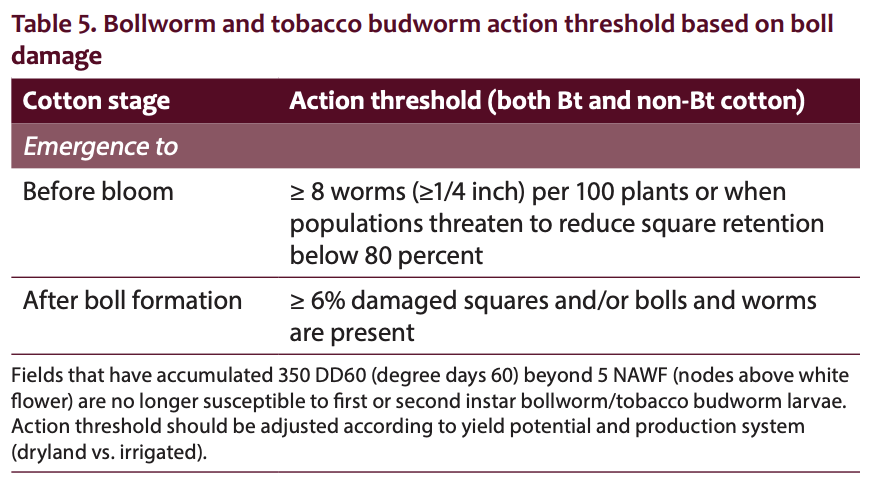
  To scout for cotton bollworms I use the terminal and square inspection method. I make about four stops in a field, more if the field is larger than 100 acres. At each stop, I look at 25 plant terminals, checking the upper third of the plant for caterpillars and eggs. I also pull 25 half grown or larger green squares to bolls and look for bollworm damage. This week there were a few moths flying around in a couple of the fields in Matagorda county, and in one near Palacios we found two eggs laid. When documenting egg lay, if I find more than one on a leaf, I only count it as one. This caterpillar is highly cannibalistic, and generally only one caterpillar will result from eggs too near each other. The economic threshold for bollworms is 6% damaged bolls with live caterpillars present. In areas like ours on the upper gulf coast with documented Bt failures, the threshold for eggs on single and dual gene cotton is 20% (20 plants out of 100 with at least one egg). If you're finding bollworms in cotton or in corn, especially in viptera fields, please give me a call.

Cotton Insect Guide
 The current A&M recommendation is to use pyrethroids with caution. In areas needing residual control Prevathon at 18-20 fl oz or Besiege at 9-10 fl oz works well. If you don't need residual control you can get by with Prevathon at 14 fl oz or Besiege at 7-8 fl oz.

Cotton Insect Guide
  
Heat Unit Accumulation for Wharton, TX


  Corn this week has had southern rust picking up in places. This disease can spread rapidly, and places you see it should be monitored daily. Check out Tom Isakeit's publication on this fungus.

  I hope you all have a good weekend. If you're not sure what kind of insect or issue you have, feel free to drop by the Wharton county office or give us a call.

Sincerely,

Kate Harrell

Looking for more information? Check out the Cotton Insect Guide

Need help with weed control? Check out the Weed Management Guide

Need info on Southern Rust? Check out this Southern Rust of Corn publication

Friday, June 7, 2019

Fleahoppers and Bollworms

H. zea moth
Kate Harrell
Howdy,

  This week I've seen cotton starting to bloom in all three counties. In the younger cotton we continue to monitor for cotton fleahoppers feeding on squares. In older cotton with blooms I have started looking for bollworms. Bollworms, Helicoverpa zea, are caterpillars that feed on multiple crops and vegetables. In cotton they feed on squares and bolls, causing fruit loss. The last few years we had high numbers of this insect even in our Bt cotton.

H. zea caterpillar in cotton square
Kate Harrell
  To scout for cotton bollworms I use the terminal and square inspection method. I make about four stops in a field, more if the field is larger than 100 acres. At each stop, I look at 25 plant terminals, checking the upper third of the plant for caterpillars and eggs. I also pull 25 half grown or larger green squares to bolls and look for bollworm damage. This week there were a few moths flying around in a couple of the fields in Matagorda county, and in one near Palacios we found two eggs laid. When documenting egg lay, if I find more than one on a leaf, I only count it as one. This caterpillar is highly cannibalistic, and generally only one caterpillar will result from eggs too near each other. The economic threshold for bollworms is 6% damaged bolls with live caterpillars present. In areas like ours on the upper gulf coast with documented Bt failures, the threshold for eggs on single and dual gene cotton is 20% (20 plants out of 100 with at least one egg). If you're finding bollworms in cotton or in corn, especially in viptera fields, please give me a call.

Cotton Insect Guide
 The current A&M recommendation is to use pyrethroids with caution. In areas needing residual control Prevathon at 18-20 fl oz or Besiege at 9-10 fl oz works well. If you don't need residual control you can get by with Prevathon at 14 fl oz or Besiege at 7-8 fl oz.

Cotton Insect Guide

  I know that once it begins to dry we may want to get into the field and add a Plant Growth Regulator to your tank, but please keep in mind that waterlogged conditions also inhibit plant hormones. Be cautious of applying PGRs too soon after heavily waterlogged conditions, as applying PGRs too soon could further decrease yield potential, especially in some varieties. Talk to your seed company about the recommended PGR regiment for each variety.

  I hope everyone has a good weekend and doesn't get too muddy out there! If you're not sure what kind of insect or issue you have, feel free to drop by the Wharton county office or give us a call.

Sincerely,

Kate Harrell

Looking for more information? Check out the Cotton Insect Guide

Need help with weed control? Check out the Weed Management Guide


Friday, May 31, 2019

Fleahoppers

Howdy,

  This week I was under the weather a bit, but in the scouting I did get to I saw cotton fleahoppers in lower numbers. This was didn't surprise me since most of the places I check with squaring cotton have been treated for fleahoppers sometime in the last two weeks. I did see one more verde plant bug in Jackson county this week as well. The threshold for verde plant bugs is 20-25 insects per 100 plants with using a beat bucket. Verdes can feed on fruit up to bolls about an inch in diameter.

Nymph (A) and adult (B) of Verde plant bug, Creontiades signatus Distant (Hemiptera: Miridae), which causes lint and seed staining and deterioration, seen in green (C) and open (D) cotton bolls. https://ccag.tamu.edu/entomology/

  Fleahoppers feeds on plant materials, and will feed on cotton squares. Keep a sharp eye out for this insect, the adults are very flighty and are often easily scattered when walking fields. I try not to let my shadow hit a plant before I get close enough to look at it so I can see the adults before they fly. Below I have two photos, one of the nymph and one of the adult insect. The nymphs of these insects are also quite small, about the size of an aphid. They are also a pale green color, but lack wings. They lack cornicles (tailpipes) that an aphid would have, and tend to be more mobile than an aphid. Fleahopper nymphs also lack the bands on the antennae a few other species of plant bugs have, and have a similar body shape to the adult bug.

Cotton Fleahopper Nymph
Kate Harrell

Cotton Fleahopper Adult
Kate Harrell

  Fleahopper feeding will cause squares to drop. Plants can recover for and compensate for some square loss, but the threshold for fleahoppers is 15-25 per 100 plants. I check for fleahoppers by inspecting the plant terminals once they start squaring. I look at 25 plants per stop in the field, usually checking 100 plants total in an 80-100 acre field, more if the field is larger.


  The chart above with action thresholds if from the cotton insect guide, and the one below containing insecticide suggestions is from cottonbugs.tamu.edu.


 I am currently looking for sugarcane aphids in sorghum fields as well. I've found them with little difficulty in johnson grass, but have not located them in field in Jackson or Matagorda counties yet. If you have some, please let me know and I can confirm their presence in the county for our sugarcane aphid mapping project.

  If you're not sure what kind of insect you have, feel free to drop it by the Wharton county office.

Sincerely,

Kate

Looking for more information? Check out the Cotton Insect Guide

Need help with weed control? Check out the Weed Management Guide

Friday, May 24, 2019

Fleahoppers and Verdes


Howdy,

  This week I have seen low thrips numbers and moderate fleahopper numbers in the fields in the Wharton, Jackson and Matagorda county area. The threshold for thrips is an average of 1 thrips per true leaf until the 5th leaf stage. While leaf cupping and curling can be signs of thrips damage, most of the curling I've seen this year was due to wind damage, not thrips. If there is a silver looking sheen on the underside of leaves, that can be attributed to thrips.

  I saw cotton fleahoppers in lower numbers than last week in squaring cotton fields this week. The highest population I saw was in a different field near Palacios, close to the Jackson/ Matagorda county line, with 31% of plants with fleahoppers (mostly nymphs) and 1 verde plant bug. The threshold for verde plant bugs is 20-25 insects per 100 plants with using a beat bucket. Verdes can feed on fruit up to bolls about an inch in diameter. This field had not yet been treated. 

Nymph (A) and adult (B) of Verde plant bug, Creontiades signatus Distant (Hemiptera: Miridae), which causes lint and seed staining and deterioration, seen in green (C) and open (D) cotton bolls. https://ccag.tamu.edu/entomology/


In another field near Palacios I found 14% fleahoppers with mostly nymphs present. In Jackson county I found fleahoppers at 2% near El Toro and 3% near Vanderbilt. In Wharton county I found 10% and 1% in the crescent area. One field near the airport I was unable to check due to being treated for fleahoppers. This insect feeds on plant materials, and will feed on cotton squares. Keep a sharp eye out for this insect, the adults are very flighty and are often easily scattered when walking fields. I try not to let my shadow hit a plant before I get close enough to look at it so I can see the adults before they fly. Below I have two photos, one of the nymph and one of the adult insect. The nymphs of these insects are also quite small, about the size of an aphid. They are also a pale green color, but lack wings. They lack cornicles (tailpipes) that an aphid would have, and tend to be more mobile than an aphid. Fleahopper nymphs also lack the bands on the antennae a few other species of plant bugs have, and have a similar body shape to the adult bug.

Cotton Fleahopper Nymph
Kate Harrell

Cotton Fleahopper Adult
Kate Harrell

  Fleahopper feeding will cause squares to drop. Plants can recover for and compensate for some square loss, but the threshold for fleahoppers is 15-25 per 100 plants. I check for fleahoppers by inspecting the plant terminals once they start squaring. I look at 25 plants per stop in the field, usually checking 100 plants total in an 80-100 acre field, more if the field is larger.


  The chart above with action thresholds if from the cotton insect guide, and the one below containing insecticide suggestions is from cottonbugs.tamu.edu.

  
 This week in one of my cotton fields near Elm Grove I noticed a good bit of turned up dirt, especially near one end of the field. Feral hogs churned up the ground and uprooted some of the cotton out there. We don't currently have a set economic threshold for hogs in cotton, but if you're looking for information on this animal check out this website.

 I am currently looking for sugarcane aphids in sorghum fields as well. I've found them with little difficulty in johnson grass, but have not located them in field in Jackson or Matagorda counties yet. If you have some, please let me know and I can confirm their presence in the county for our sugarcane aphid mapping project.

  Mosquito control is on many people's minds with the recent rains. Check out this publication on backyard mosquito control and this website on insect information and control options.
  If you're not sure what kind of insect you have, feel free to drop it by the Wharton county office.
  Happy Memorial day, everyone!

Sincerely,

Kate

Looking for more information? Check out the Cotton Insect Guide

Need help with weed control? Check out the Weed Management Guide

Friday, May 17, 2019

Fleahoppers and Lygus

Cotton Fleahopper Adult
Kate Harrell

Howdy,

  This week I have seen low thrips numbers and low fleahopper numbers in the fields in the Wharton, Jackson and Matagorda county area. The threshold for thrips is an average of 1 thrips per true leaf until the 5th leaf stage. While leaf cupping and curling can be signs of thrips damage, most of the curling I've seen this year was due to wind damage, not thrips.

  I saw cotton fleahoppers in lower numbers than last week in squaring cotton fields this week. The highest population I saw was in a field near Palacios again, with 13% of plants with fleahoppers, and more than half of those were early instar nymphs. This field was treated last week before the rain, and had 45% fleahoppers present before treatment. In another field a little off 35 near the Jackson/ Matagorda county line I found 3% with mostly adults present. Two other locations I visited with squaring cotton in Wharton county near the crescent area had 1% and 2% fleahoppers present. This insect feeds on plant materials, and will feed on cotton squares. Keep a sharp eye out for this insect, the adults are very flighty and are often easily scattered when walking fields. I try not to let my shadow hit a plant before I get close enough to look at it so I can see the adults before they fly. Above I have two photos of the adult insect and one of a nymph. The nymphs of these insects are also quite small, about the size of an aphid. They are also a pale green color, but lack wings. They lack cornicles (tailpipes) that an aphid would have, and tend to be more mobile than an aphid. Fleahopper nymphs also lack the bands on the antennae a few other species of plant bugs have, and have a similar body shape to the adult bug.

Cotton Fleahopper Nymph
Kate Harrell

Cotton Fleahopper Adult
Kate Harrell

  Fleahopper feeding will cause squares to drop. Plants can recover for and compensate for some square loss, but the threshold for fleahoppers is 15-25 per 100 plants. I check for fleahoppers by inspecting the plant terminals once they start squaring. I look at 25 plants per stop in the field, usually checking 100 plants total in an 80-100 acre field, more if the field is larger.


  The chart above with action thresholds if from the cotton insect guide, and the one below containing insecticide suggestions is from cottonbugs.tamu.edu.


Lygus Bug Adult
Kate Harrell
  This week in a field near El Toro I spotted two Lygus bugs on cotton. I have seen these insects on the weeds in field margins and in ditches in all three counties as well. This insect can feed on cotton squares, blooms, and small bolls. This can cause square loss, damaged anthers in blooms, and boll loss. The threshold for this insect is in the chart below. I am not currently concerned about damage from these insects since they are mostly in weedy margins. Once we start getting our weeds more under control, they could definitely pose a threat. The action thresholds for this insect are included in the chart below.


  I am currently looking for sugarcane aphids in sorghum fields as well. I've found them with little difficulty in johnson grass, but have not located them in field in any of my counties yet. If you have some, please let me know and I can confirm their presence in the county for our sugarcane aphid mapping project.
  Mosquito control is on many people's minds with the recent rains. Check out this publication on backyard mosquito control and this website on insect information and control options.
  If you're not sure what kind of insect you have, feel free to drop it by the Wharton county office.
  Have a good weekend, everyone!
Sincerely,

Kate
Looking for more information? Check out the Cotton Insect Guide

Need help with weed control? Check out the Weed Management Guide

Friday, May 10, 2019

Fleahoppers


Cotton Fleahopper Adult
Kate Harrell

Cotton Fleahopper Adult
Kate Harrell

Cotton Fleahopper Nymph
Kate Harrell
Howdy,

  This year I have seen low thrips numbers in the fields in the Wharton, Jackson and Matagorda county area. The threshold for thrips is an average of 1 thrips per true leaf until the 5th leaf stage. While leaf cupping and curling can be signs of thrips damage, most of the curling I've seen this year was due to wind damage, not thrips.

  I saw cotton fleahoppers in every field with squaring cotton this week. The highest population I saw this week was in a field near Palacios, with 45% of plants with fleahoppers. This insect feeds on plant materials, and will feed on cotton squares. Keep a sharp eye out for this insect, the adults are very flighty and are often easily scattered when walking fields. I try not to let my shadow hit a plant before I get close enough to look at it so I can see the adults before they fly. With the wind we were having it was actually easier to find the adult fleahoppers. They tend to hunker down into the plant instead of taking flight when it's windy. Above I have two photos of the adult insect and one of a nymph. The nymphs of these insects are also quite small, about the size of an aphid. They are also a pale green color, but lack wings. They lack cornicles (tailpipes) that an aphid would have, and tend to be more mobile than an aphid. Fleahopper nymphs also lack the bands on the antennae a few other species of plant bugs have, and have a similar body shape to the adult bug.

  Fleahopper feeding will cause squares to drop. Plants can recover for and compensate for some square loss, but the threshold for fleahoppers is 15-25 per 100 plants. I check for fleahoppers by inspecting the plant terminals once they start squaring. I look at 25 plants per stop in the field, usually checking 100 plants total in an 80-100 acre field, more if the field is larger.

  The chart below contains insecticide suggestions from cottonbugs.tamu.edu (also a good resource) for reference if you have fleahoppers at the action threshold. Two locations I looked at this week could have considered treatment with a ground rig, but everywhere else I looked for them was too wet. I'd like to note that drowning is not my preferred method for controlling fleahoppers.


  I am currently looking for sugarcane aphids in sorghum fields as well. I've found them with little difficulty in johnson grass, but have not located them in field in any of my counties yet. If you have some, please let me know and I can confirm their presence in the county for our sugarcane aphid mapping project.

  This week I received a couple of phone calls and emails with questions on Texas leaf cutter ants and fire ants. Both these species are currently producing mating flights. For information on biology and management on fire ants check out this website, and for leaf cutter ants check out this one

  We also had a bumper crop of forest tent caterpillars about a month ago, and now there are a bunch of their moths flying around. If you wondered what all the small, fuzzy, tan moths were, now you know- forest tent caterpillars. 

  If you're not sure what kind of insect you have, feel free to drop it by the Wharton county office.

  I hope everyone stays safe and drier than we are currently anticipating out there. Good luck all, and as always feel free to call or email with any questions or concerns.

Sincerely,

Kate

Looking for more information? Check out the Cotton Insect Guide

Wednesday, April 3, 2019

Small Grains Field Day

Small Grains Field Day in Egypt, TX – April 17, 2019

By Corrie Bowen
County Extension Agent – Agriculture/Natural Resources
Wharton County

Texas A&M Agrilife Extension will be hosting a Wheat Field Day at Krenek Seed near Egypt, Texas on Wednesday, April 17, 2019.  The Krenek’s have cooperated this year by providing ground for Dr. Clark Neely, Extension Small Grains Specialist to conduct our Upper Gulf Coast wheat variety trial.  The tour will offer us the opportunity to view not only hard red winter wheat varieties, but also soft red and spring wheat varieties.

The program will begin at 9:00 a.m. at the wheat trial plot located at the Krenek Seed headquarters near Egypt.

Dr. Clark Neely, Extension Small Grains Specialist will begin the field day by providing information on variety selection and performance traits of certain wheat varieties.  Other topics to include Rust Management in Wheat—Dr. Tom Isakeit, Extension Plant Pathologist; Insect Pest Management, Stephen Biles – CEA, Integrated Pest Management; Weed Problems and Management in Wheat, Dr. Josh McGinty—Extension Agronomist; Wheat Market Outlook – Mark Welch, Extension Economist; Canola Market Situation Update – Josh McGinty .  

The field day will conclude at 11 a.m.  We’ll be done just in time if you want to make it over to the Antique Tractor Show and Hot Dog Fundraiser ($1.00 hot dog and drink supports the local FFA) at Superior Motor Parts at 214 N. Mechanic in El Campo (lunch 11 a.m. to 1 p.m.).

There is no cost to participants to attend the small grains field day. 2.0 CEUs will be offered to all TDA Pesticide License Holders.  CCA credits will be offered to certified crop advisors, pending course approval.  Anyone wanting to attend is asked to contact Stacey at the Texas A&M AgriLife Extension Service office in Wharton County at 979-532-3310  to pre-register.  You can find a complete program flyer by clicking on EVENTS at http://wharton.agrilife.org
-30-

Friday, February 15, 2019

Howdy all, 

I'd like to share this notice from our local USDA office on the NRCS Local Working Group meeting to be held on February 19, 2019.

Friday, February 8, 2019

Auxin Trainings

Howdy,

If anyone needs an additional Certified Crop Advisor CEU, read this article and take the quiz linked in the article.

If you need auxin herbicide trainings, check out the information below.


Series of auxin herbicide trainings for area producers set for February - April

By Corrie Bowen
County Extension Agent
Wharton County

The Texas A&M AgriLife Extension Service will conduct a series of Auxin Trainings for producers in the Wharton and Matagorda County area from February – April 2019.  This special, annual training that was required  last year for the new dicamba formulations applied on tolerant cotton and soybean crops,  will now be a two-hour training.  In addition to the EPA mandated dicamba applicator training, the Texas Department of Agriculture has added 2,4-D Choline formulations (Enlist Duo® and Enlist One) for use on 2,4-D tolerant crops to be included in the annual mandatory auxin trainings. The two hour 2019 mandated Auxin Training will include the following topics:  1) why do auxin herbicides require additional precautions, 2) label requirements for approved auxin formulations, 3) understanding temperature inversions, 4) spray system hygiene, 5) record keeping, and 6) using dicamba and 2,4-D in a weed management system. 

The extended dicamba labels for 2019-2020 include changes to ensure the new dicamba technology products continue to be used effectively and to address concerns about off-target movement.  New for 2019-2020, dicamba technology herbicide applications will be limited to certified applicators only.  Some of these new changes may be different before the 2019 growing season pending 24C requests that have been submitted to the Texas Department of Agriculture (TDA).  Upon approval, the 24c labels will be available on the Texas Department of Ag website (www.texasagriculture.gov/RegulatoryPrograms/Pesticides).

The Enlist products are State Limited Use pesticides in Texas.  In contrast to the dicamba technology products, the Enlist products can be sold to and used by certified applicators or those working under the supervision of a certified applicator. 

The training is not required for those using range and pasture labeled dicamba and/or 2,4-D products.  The Auxin Specific Herbicide training is an annual training.  Completion of the annual Auxin training is not required to purchase seed or chemistry, it is only required annually, prior to applying Engenia, Xtendimax, Fexapan, EnlistOne and/or EnlistDuo  herbicides.  

The Wharton and Matagorda County Extension Offices have arranged a series of dates, times and locations for the Extension Auxin trainings.  Pick a date and time that is conducive to your schedule:

February 21, 2019
2:00 P - 4:00 P
Matagorda County Extension Office
February 28, 2019
9:00 A - 11:00 A
Wharton County Extension Office
March 7, 2019
9:00 A - 11:00 A
Wharton County Extension Office
March 21, 2019
2:00 P - 4:00 P
Matagorda County Extension Office
March 28, 2019
9:00 A - 11:00 A
Wharton County Extension Office
April 4, 2019
9:00 A - 11:00 A
Matagorda County Extension Office
April 11, 2019
9:00 A - 11:00 A
Wharton County Extension Office
April 18, 2019
9:00 A - 11:00 A
Northside Education Center—El Campo
April 25, 2019
9:00 A - 11:00 A
Matagorda County Extension Office

Each program will last two hours and will provide two (2) Texas Department of Agriculture laws and regulations continuing education units (CEUs) and will meet the annual Auxin training requirement for 2019.  An applicator or operator must attend only one of these available trainings in 2019.  We reached 148 pesticide applicators at the Feed Grain and Cotton Conference with the required Auxin training, however, there will be more cotton and soybean producers who will need to complete this annual training.  Therefore, we’re providing these nine trainings through April 25th.  We’ll continue to provide these trainings through the growing season as needed .  A flyer for this series of Auxin Trainings can be found at http://wharton.agrilife.org  For any questions regarding the Auxin trainings, contact Corrie Bowen at 979-532-3310 or Aaron Sumrall at 979-245-4100.

-30-