Texas A&M Agrilife Extension Logo

Texas A&M Agrilife Extension Logo

Friday, April 24, 2020

Thrips, Fleahoppers, and Wind


Howdy,

  This week I got pretty sand blasted while scouting. It's been dry and windy, and I've seen cotton with damaged stalks and leaves from the wind, as well as some stand reduction. This year I've seen the usual burned leaves in addition to stalks getting whipped around by the wind, then seedlings wilting from introduction of plant disease, like rhizoctonia, from the injury sites at the base of the stalk. If you've got stand reduction, fields can still be considered viable with stand counts as low as 13,000 to 26,000 plants per acre, as long as they are fairly evenly spaced.

Cotton Seedling with Damaged Stalk
Photo: Kate Crumley

  I've seen very low thrips numbers this week, even in fields that hadn't been treated for them. I am still seeing low numbers of aphids in all three counties, but no fields at levels that would warrant concern. I did see spider mites again in a field in Wharton county near the fairgrounds, but also in very low numbers.

  Thrips are a small (about 1/15") light tan or straw colored insect with a punch and suck type mouthpart and asymmetrical mandibles. They punch a hole with one side, then siphon the juice out with the other. They feed one plant cell at a time, and march along punching and sucking as they go. The adults are winged, can travel short distances on their own, and can be carried by a breeze for a fair distance. Larvae hide on the underside of the leaves, often close to the leaf veins, as well as in the terminal of the plant. Feeding damage for this insect causes the leaves to crinkle and curl, and often looks silvery when examined. Thrips feeding can cause delays in plant maturity and eventual yield reduction.

Western Flower Thrips Adult
Photo: Kate Crumley
  While the insects are visible to the naked eye and scouting can be done just by examining the plant, it is easy to miss some of the smaller larvae. Smacking a cotton plant around on the inside of a cup will knock them off and can make them easier to count. This video Blayne Reed put together has techniques for scouting thrips as well. Cotton with a neonicotinoid seed treatment is usually safe from thrips for about 2-3 weeks after emergence. Seedlings in a sandier soil will lose the effects of a seed treatment more quickly than those in heavier clay soils. Rainfall can also impact how long the seed treatments are effective, the more it rains the shorter the amount of time the seed treatment stays effective. 
Thrips Feeding Damage
Photo: Kate Crumley
   The economic threshold for thrips is one thrips per true leaf of the plant until the 5th true leaf stage. Once the plant reaches this stage, treatment for thrips is rarely justified. Check out the cotton insect guide at this website for more information.

Aphids on Cotton
Photo: Kate Crumley
  The threshold for cotton aphids is 50 aphids per leaf, and if you see the aphid mummies in the field, that's a good thing. Parasitoid wasps lay eggs in the aphids, and the aphid forms a mummy while the wasp larvae pupates inside. These wasps, lady beetles, and lacewings all can make a dent in aphid numbers. Treatment for aphids is very rarely justified since the numbers need to be so high before they can cause an economic problem. If you do decide to treat for aphids, do not use a pyrethroid. Pyrethroids are non specific, and kill predatory insects as well, but aphids will bounce back quickly due to their high reproductive rate. 


Spider Mites on Cotton
Photo: Kate Crumley

 The spider mite populations I've seen have been pretty low. The humidity here normally keeps their numbers from getting too high, but it has been a bit less humid here lately. If you are concerned about a field, there is more information on this website. 


Cotton Fleahopper Adult
Kate Crumley

  I've not seen cotton fleahoppers at threshold yet, but I was finding them even in fields that were not squaring yet this week. I had two fields with fleahoppers that were squaring this week. One field near El Toro had 9 fleahoppers on 100 plants, and one near the airport had 2 in 100 plants. 


  Fleahopper feeding will cause squares to drop. Plants can recover for and compensate for some square loss, but the threshold for fleahoppers is 15-25 per 100 plants. I check for fleahoppers by inspecting the plant terminals once they start squaring. I look at 25 plants per stop in the field, usually checking 100 plants total in an 80-100 acre field, more if the field is larger. Fleahopper nymphs can be close to the size of aphids, but look like smaller versions of the adults without wings, and are much more mobile than aphids.

  The chart below contains insecticide suggestions from cottonbugs.tamu.edu (also a good resource) for reference if you have fleahoppers at the action threshold this upcoming week.


  If you have any questions feel free to contact me. Wash your hands everybody, and I hope it rains on those of us who need it soon.

Sincerely,

Kate Crumley

For More Information:


Saturday, April 11, 2020

Thrips, Aphids, Spidermites, and Wind

Howdy,

  This planting season on the gulf coast has ranged from a little dry to fantastic so far. Hopefully we'll catch a few rains where we need them and get everyone off to a good start. It's been windy, and I've seen cotton with damaged stalks and leaves from the wind, as well as some stand reduction. This year I've seen more stalks getting whipped around by the wind, then seedlings wilting from introduction of plant disease, like rhizoctonia, from the injury sites at the base of the stalk. If you've got stand reduction, fields can still be considered viable with stand counts as low as 13,000 to 26,000 plants per acre, as long as they are fairly evenly spaced.


Cotton Seedling with Damaged Stalk
Photo: Kate Crumley

  There have been a few thrips, aphids, and spider mites out in the fields as well. I'm a little more concerned about thrips, as the numbers of spider mites and aphids have not been at levels of concern. 


  Thrips are a small (about 1/15") light tan or straw colored insect with a punch and suck type mouthpart and asymmetrical mandibles. They punch a hole with one side, then siphon the juice out with the other. They feed one plant cell at a time, and march along punching and sucking as they go. The adults are winged, can travel short distances on their own, and can be carried by a breeze for a fair distance. Larvae hide on the underside of the leaves, often close to the leaf veins, as well as in the terminal of the plant. Feeding damage for this insect causes the leaves to crinkle and curl, and often looks silvery when examined. Thrips feeding can cause delays in plant maturity and eventual yield reduction.


Western Flower Thrips Adult
Photo: Kate Crumley
  While the insects are visible to the naked eye and scouting can be done just by examining the plant, it is easy to miss some of the smaller larvae. Smacking a cotton plant around on the inside of a cup will knock them off and can make them easier to count. This video Blayne Reed put together has techniques for scouting thrips as well. Cotton with a neonicotinoid seed treatment is usually safe from thrips for about 2-3 weeks after emergence. Seedlings in a sandier soil will lose the effects of a seed treatment more quickly than those in heavier clay soils. Rainfall can also impact how long the seed treatments are effective, the more it rains the shorter the amount of time the seed treatment stays effective. 
Thrips Feeding Damage
Photo: Kate Crumley
   The economic threshold for thrips is one thrips per true leaf of the plant until the 5th true leaf stage. Once the plant reaches this stage, treatment for thrips is rarely justified. Check out the cotton insect guide at this website for more information.

Aphids on Cotton
Photo: Kate Crumley
  The threshold for cotton aphids is 50 aphids per leaf, and if you see the aphid mummies in the field, that's a good thing. Parasitoid wasps lay eggs in the aphids, and the aphid forms a mummy while the wasp larvae pupates inside. These wasps, lady beetles, and lacewings all can make a dent in aphid numbers. Treatment for aphids is very rarely justified since the numbers need to be so high before they can cause an economic problem. If you do decide to treat for aphids, do not use a pyrethroid. Pyrethroids are non specific, and kill predatory insects as well, but aphids will bounce back quickly due to their high reproductive rate. 


Spider Mites on Cotton
Photo: Kate Crumley

 The spider mite populations I've seen have been pretty low. The humidity here normally keeps their numbers from getting too high, but it has been a bit less humid here lately. If you are concerned about a field, there is more information on this website. 


Cotton Fleahopper Adult
Kate Crumley

  This upcoming week I anticipate I will be looking for fleahoppers as earlier field begin to put squares on. 
Fleahopper feeding will cause squares to drop. Plants can recover for and compensate for some square loss, but the threshold for fleahoppers is 15-25 per 100 plants. I check for fleahoppers by inspecting the plant terminals once they start squaring. I look at 25 plants per stop in the field, usually checking 100 plants total in an 80-100 acre field, more if the field is larger.

  The chart below contains insecticide suggestions from cottonbugs.tamu.edu (also a good resource) for reference if you have fleahoppers at the action threshold this upcoming week.


  If you have any questions feel free to contact me. Stay safe and wash your hands!

Sincerely,

Kate Crumley

For More Information:


Friday, March 27, 2020

Essential Worker Travel Form

Howdy everybody,

I've provided a link for the essential worker travel form for those of you in cities or counties with shelter in place restrictions. This website will have updated versions of this form if it changes. The Texas Department of Agriculture posted this form on their website here:
https://www.texasagriculture.gov/NewsEvents/COVID19CoronavirusResponsePage.aspx

The current form can be found here:
https://www.texasagriculture.gov/Portals/0/forms/COMM/Essential_Worker_Travel_Form_3.25.2020.pdf

I was in a webinar yesterday where we heard that a few folks have been pulled over and needed this form. It's not currently practice for anyone to be asking for this form, but it might not be a bad idea to have it with you just in case.

Our extension office in Wharton is currently closed, but open by appointment. Feel free to give us a call or send me an email if you guys need anything. Stay safe and wash your hands everyone!

Sincerely,

Kate Crumley

Tuesday, March 24, 2020

Forest Tent Caterpillars

Howdy!

  Our office has been getting a lot of calls lately on caterpillars. Most of these are forest tent caterpillars. These caterpillars attack a wide array of tree and shrub species, and are medically harmless even though they're fuzzy. Most trees can handle the loss of up to 20% of their foliage without harm, and many can re-leaf even after complete defoliation if there are no other stressors, so treatment for these caterpillars is rarely warranted.
  You can protect some of the tree by treating with an insecticide from a hose end sprayer, such as Spinosad or a Bacillus thuringiensis for a lower off-target impact. Another option is spot treating the caterpillar aggregation with a spray bottle of insecticidal soap, horticultural oil, or any labelled pyrethroid insecticide. Targeted applications or use of lower impact insecticides will help preserve beneficial insect populations. If your populations are lighter, I would recommend leaving them for the birds and beneficial insects to feed on.

Forest Tent Caterpillars
Photo: Kate Crumley

  Stay safe and wash your hands, everyone!

Sincerely,

Kate Crumley


For more information:

https://citybugs.tamu.edu/2015/04/10/tent-caterpillars-without-the-tent/

https://texasinsects.tamu.edu/eastern-tent-caterpillar/

https://agrilifeextension.tamu.edu/library/gardening/tent-caterpillars/

Thursday, January 16, 2020

Feed Grain and Cotton Conference

Upper Gulf Coast Feed Grain and Cotton Conference

January 23 @ 8:00 am - 1:30 pm

Upper Gulf Coast Feed Grain and Cotton Production Conference at Crescent – January 23, 2020
By Corrie Bowen
County Extension Agent
Texas A&M AgriLife Extension Service
Wharton County
Texas A&M AgriLife Extension in Wharton, Matagorda, Jackson, and Colorado Counties are happy to announce the Upper Gulf Coast Feed Grain and Cotton Conference for Thursday, January 23, 2020.   This year’s conference will be held in Crescent Hall at the Wharton County Fairgrounds at 6036 FM 961 Road Wharton, Texas 77488.  Registration begins at 8:00 a.m., with our first speaker beginning at 8:30 a.m.  The conference will include a catered lunch meal will conclude at 1:45 p.m.  3 CEUs will be awarded to pesticide license holders with the Texas Department of Agriculture (1 IPM, 1 L&R, 1 General); and 4.5 CEUs for Certified Crop Advisors have been applied for.  Thanks to ag industry sponsors, no registration fee will be charged.
The Feed Grain and Cotton conference will address the following topics: Bollworm and Fleahopper  Update – David Kerns, Texas IPM Coordinator; Feed Grain Research Update- Dr. Ron Schnell, Extension  Cropping Systems Specialist; Weed Control in Grain Crops – Dr. Josh McGinty, Assistant Professor and Extension Agronomist;  2020 Texas Auxin Herbicide Training Dicamba and Enlist Technologies – Dr. Scott Nolte, Extension Weed Specialist; Introduction to Gene Drive Technology – Kate Crumley, Extension Agent – IPM; Emerging Cotton Diseases -Tom Isakeit, Extension Plant Pathologist; Cotton Market Update – John Robinson, Extension Cotton Marketing Specialist; and RACE Trial Update/Current Cotton Research – Dale Mott, Extension Program Specialist.
The annual Auxin training will be a one-hour training for 2020.  The Auxin training that is provided as part of the Feed Grain and Cotton Conference will fulfill the annual auxin training requirements for Dicamba and 2,4-D Choline products and will include 1 hours of Laws and Regulations CEUs.
For more information or for a copy of the conference flyer, go to https://wharton.agrilife.org, or contact Stacey at the Wharton County Extension Office at (979) 532-3310, or stacey.shanks@ag.tamu.edu.  Please call or email Stacey by 12 noon on January 22nd just to let us know that you’ll be attending.
The members of Texas A&M AgriLife will provide equal opportunities in programs and activities, education, and employment to all persons regardless of race, color, sex, religion, national origin, age, disability, genetic information, veteran status, sexual orientation or gender identity and will strive to achieve full and equal employment opportunity throughout Texas A&M AgriLife.
The Texas A&M University System, U.S. Department of Agriculture, and the County Commissioners Courts of Texas Cooperating.  Individuals with disabilities who require an auxiliary aid, service or accommodation in order to participate in any Extension activity, are encouraged to contact the County Extension Office for assistance 5 days prior to the activity.


Wednesday, January 8, 2020

CEUs

Howdy,

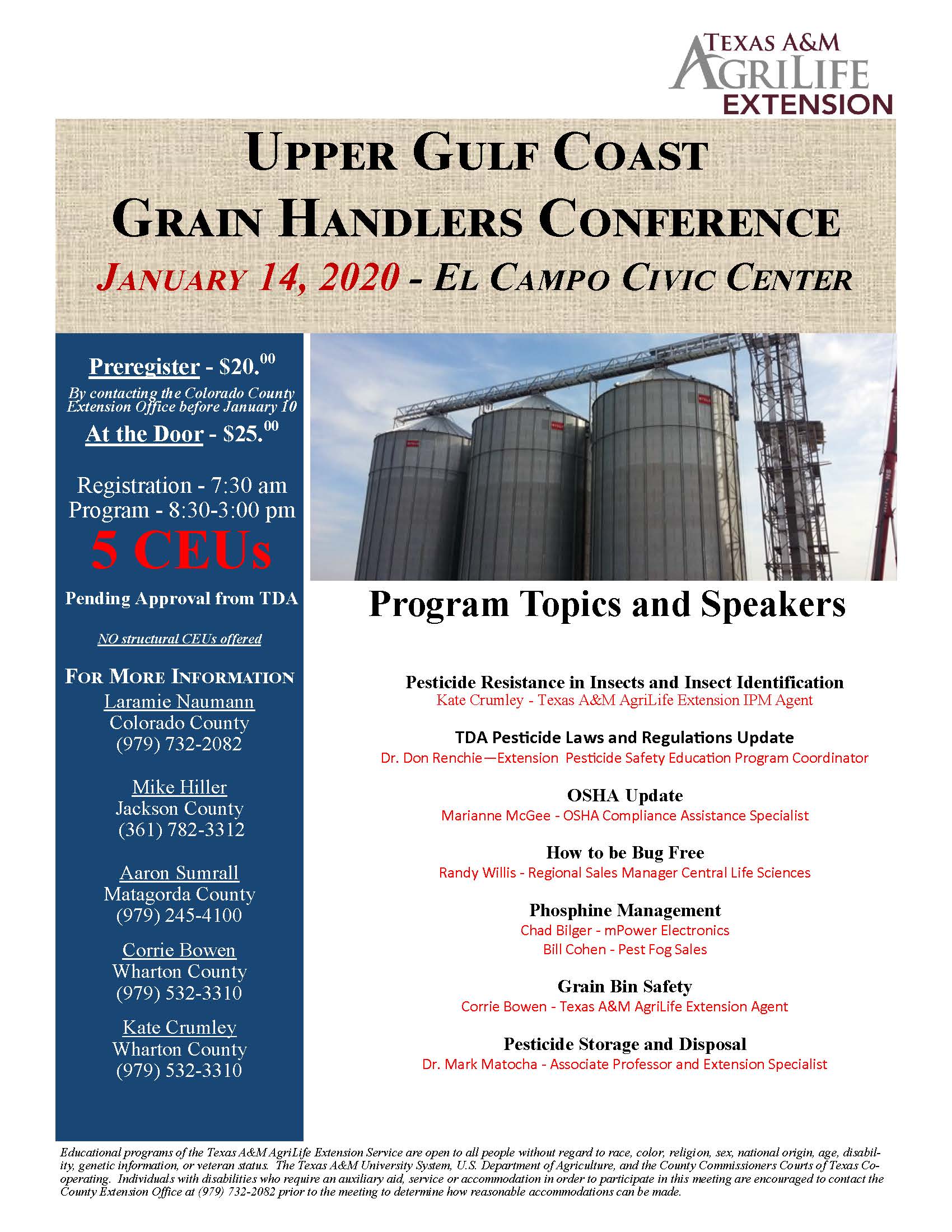
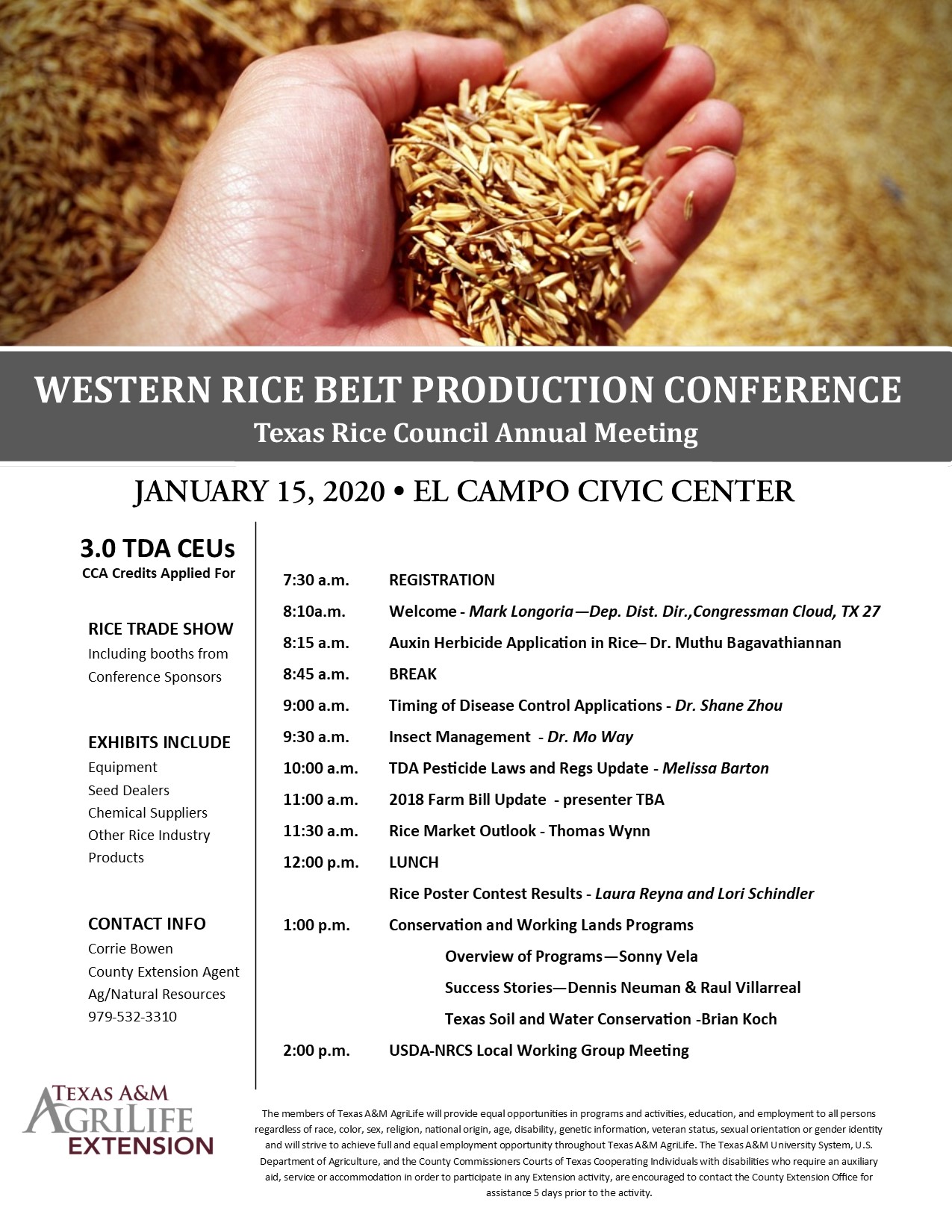
  I hope everyone had a merry Christmas and a happy new year! We've got two programs coming up next week for those of you needing CEUs for your pesticide applicator's license. Please check out the flyers below, and feel free to send me an email or give our office a call if you have any questions.


Sincerely,

Kate

Monday, December 2, 2019

Industrial Hemp Seminar

Industrial Hemp Seminar December 10th in Wharton

By Corrie Bowen

County Extension Agent
Wharton County


Anyone who’s been keeping up with current events in agriculture will know that there’s a growing interest in growing industrial hemp.  This new interest began with the enacted 2018 Farm Bill, which legalized hemp with a tetrahydrocannabinol (THC) concentration of no more than 0.3% on a dry-weight basis. Thus, the 2018 Farm Bill allows for expanding cultivation of hemp, but not marijuana. In the 86th Texas Legislative session this year, the Texas Legislature approved Industrial hemp production in Texas with House Bill 1325.  On Tuesday, October 29 USDA released their interim rules which Texas and other states will now use in crafting their state-specific guidelines for hemp production.  Now, Texas Dept. of Agriculture will work to finalize Texas rules, which must then be submitted to USDA for federal approval.
There could be opportunity for producers growing hemp, but not without careful consideration of all the risks. With no infrastructure or research on hemp in the region, we want to provide the most relevant and unbiased information for our area so producers and potential investors can make informed decisions in the outset of a potential new ag industry.  To begin this process of educating potential producers, an industrial hemp seminar will be held on December 10, 2019 by the Texas A&M AgriLife Extension Service, in cooperation with the Wharton Economic Development Corporation at the Wharton Civic Center in Wharton, Texas.  The Wharton Civic Center is located at 1924 N. Fulton St, Wharton, Texas 77488.
Registration will begin at 6 p.m.  The seminar will begin at 6:30 p.m. with a brief welcome from Corrie Bowen, Wharton County Extension Agent, and Chad Odom, Director – Wharton Economic Development Corporation.  Our first guest speaker, Calvin Trostle, Ph.D., AgriLife Extension agronomist, Lubbock, will provide an introduction to the hemp industry. He will discuss hemp products and processing as well as the differences in growing seeds and transplants, growing for CBD oil or fiber, and agronomic considerations for growing industrial hemp.  Dr. George Knapek, Texas A&M AgriLife Agriculture and Food Policy Specialist will present the Economic Considerations for Industrial Hemp in Texas. Dr. Trostle and Dr. Knapek will allow time for questions and answers.  The program will conclude at 9:00 p.m.  If you are interested in attending the Industrial Hemp Seminar, please call Stacey by 5 p.m. on December 9 at the Wharton County Extension Office at 979-532-3310 to let us know that you’ll be attending.  The fee is $20/person, which can be paid at the door on December 10th.  Individuals with disabilities who require an auxiliary aid, service or accommodation in order to participate in any Extension activity, are encouraged to contact the Wharton County Extension Office at 979-532-3310 for assistance 5 days prior to the activity.
The members of Texas A&M AgriLife will provide equal opportunities in programs and activities, education, and employment to all persons regardless of race, color, sex, religion, national origin, age, disability, genetic information, veteran status, sexual orientation or gender identity and will strive to achieve full and equal employment opportunity throughout Texas A&M AgriLife. The Texas A&M University System, U.S. Department of Agriculture, and the County Commissioners Courts of Texas Cooperating
-30-

Friday, September 27, 2019

Cotton, grain risk management workshop October 17th at Wharton Fairgrounds

Corrie Bowen
County Extension Agent
Wharton County

A cotton and grain risk management marketing workshop is scheduled for Thursday, Oct. 17 at the Wharton County Fairgrounds in Crescent, Texas.  The Wharton County Fairgrounds is located at 6036 FM 961 Rd. Registration begins at 8 a.m.  Our first presentation will begin at 8:30 a.m.
The workshop is sponsored by the Wharton County AgriLife Extension Office and the Wharton County Row Crops Committee.
“This is an excellent opportunity to be briefed on the need for budgeting, decision tools, outlook and making marketing plans for the next crop year,” said Mac Young, Texas A&M AgriLife Extension Service program specialist, Corpus Christi.
The following is a schedule of speakers and topics:
Budgeting and Decision Tools, Mac Young.
Cotton Outlook, Dr. John Robinson, AgriLife Extension Cotton Marketing Economist.
Grain Outlook, Dr. Mark Welch, Extension Economist – Grain Marketing.
Marketing Strategies, Robinson and Welch.
‘What If” Scenarios, Discussion and Questions, Robinson and Welch
The workshop will conclude at 12:00 p.m. with a meal. Please RSVP by calling Stacey at 979-532-3310 by 12 noon on Wednesday, October 16th.

-30-

Friday, August 9, 2019

Wrapping Up

Howdy,

Our grain in the upper gulf coast is being harvested, and most of our cotton is finishing out and past concern for insect pressure. The heat units for each county for August 1- 7 are below:

Wharton: 175
Jackson: 187
Matagorda: 183

Below I have included our cotton defoliation trial results from 2017, and I will include this year's trial information as soon as we have it. We treated the first set of treatments this Tuesday, and plan on making follow up applications next Tuesday. Please feel free to call our office if you have any questions or concerns. Stay safe harvesting, everyone!

Results for the cotton defoliation study that was sprayed on July 28, 2017 in Wharton, Texas are listed below.  A rating of the July 28th application (Application Timing A)  of 13 different defoliation treatments was taken on August 2, 2017.  The percentages given for % Defoliation, % Desiccation, % Green Leaf, and % Open Boll for the attached report is a measure of only Application A at 5 days after spraying.  The attached report does not reflect the second application of defoliant (Application Timing B), as the treatments that called for a second spraying were not sprayed until August 4th.  Approximate cost estimates reflect total cost of the treatment (e.g.  Total cost of Treatment A and Treatment B).   I will follow up later this week with the results of the defoliation study taken at  12 days after the initial defoliation.  The second report will also reflect % regrowth for the 13 treatments.
https://wharton.agrilife.org/2017/08/09/2017-cotton-harvest-aid-rating/

Friday, August 2, 2019

Finishing up

Howdy,

Our grain in the upper gulf coast is being harvested, and most of our cotton is finishing out and past concern for insect pressure.

Below I have included our cotton defoliation trial results from 2017, and I will include this year's trial information as soon as we have it. Please feel free to call our office if you have any questions or concerns. Stay safe harvesting, everyone!

Results for the cotton defoliation study that was sprayed on July 28, 2017 in Wharton, Texas are listed below.  A rating of the July 28th application (Application Timing A)  of 13 different defoliation treatments was taken on August 2, 2017.  The percentages given for % Defoliation, % Desiccation, % Green Leaf, and % Open Boll for the attached report is a measure of only Application A at 5 days after spraying.  The attached report does not reflect the second application of defoliant (Application Timing B), as the treatments that called for a second spraying were not sprayed until August 4th.  Approximate cost estimates reflect total cost of the treatment (e.g.  Total cost of Treatment A and Treatment B).   I will follow up later this week with the results of the defoliation study taken at  12 days after the initial defoliation.  The second report will also reflect % regrowth for the 13 treatments.
https://wharton.agrilife.org/2017/08/09/2017-cotton-harvest-aid-rating/